|
 | | |  | |
 | | 1. | | 4 | 6 |  | | 1. | | 4 | 6 |  | | 3. | | 3 | 6 |  | | | | | |  | | 6. | | 3 | 4 |  | | 7. | | 1 | 3 |  | | 8. | | 0 | 3 |  | | 9. | | -1 | 3 |  | | 9. | | -1 | 3 |  | | | | | |  |
|
| |  |  |  |  |  |  |  |  | |  |  |
|  |
| |  |  |  |
 |  |  |  |  | Foto-Dokumentation der Ausbaustufe Drei |  |
| | The following pictures show the steps of the concrete and steelworks (the text is in German):
|
 |  |  |  |  | Stadium Extension Phase Three: First Pylons Hold The Roof |  |
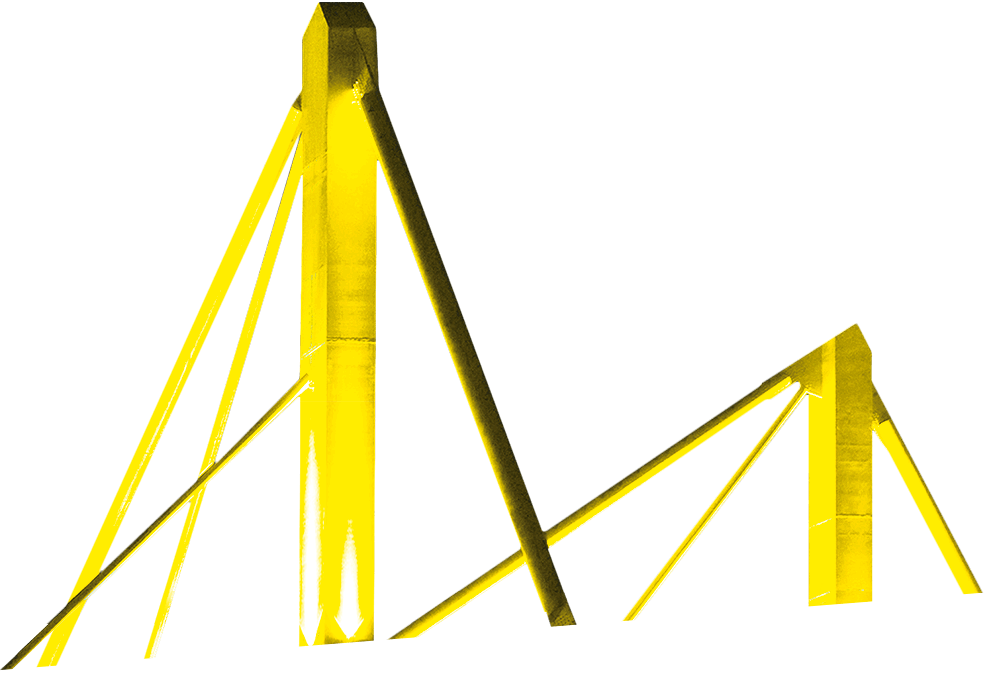
| | On 13 March, the most challenging engineering task of the third phase of the extension was completed: The first yellow steel pylon as a holder for the stadium roof on the Northwest side was installed through a special procedure.
The roof of the Westfalenstadion will be lowered with the help of these cylinders. The roof works have been carried out by a team of Swiss experts with the help of the "Litzenheber Procedure." In this process the old roof is lowered with cylinders and the new roof is stabilized. The original plan was to hydraulically lift the roof 25 centimeters however, in the end, the engineers decided to choose the special Swiss procedure. The second pylon of the new roof was installed on 20 March. While the new holders were installed, the old holders, the corner pylons, which supported the roof and would become a sight obstruction for the new seats in the completed corner areas, were dismantled piece by piece.
|
 |  |  |  |  | Stadium Enlargement: Moving Forward |  |
| | A new phase of the third Westfalenstadion renovation stage is starting on time for the new year: The concrete work is nearly complete. The steel holders for the stadium roof will now be installed. 14,500 additional seats will be available after the completion of the work in September.
The installation of the huge steel parts was done on site. The first of eight 70 meter high steel pylons was installed on 7 January in the new Nordwesttribüne area. The steel parts are up to 37 meters high and were delivered in individual parts, which will be constructed into bigger units on site and put in afterwards.
At the moment the stadium roof is held by pylons connected to a holder. A three-pylon is supporting the roof construction on each end of the roof holder. A new steel girder will be built above the pylons. The so called "Dreigurtbinder" (the big triangle-shaped holders running along each roof) will be hung on one side of each roof and then will be hydraulically lifted 24 centimeters.
The first of eight pylons has already been installed. The existing poles, which would obstruct views in the new corner seats, can be extended as soon as the new pylon construction is completed. The roof will be lowered again after the extension. In the end, the roof will have support shadowing the stadium like a crown. The installation of the pylons, started last week, should be finished by the end of January as scheduled. Specators will have access in time for the first home match.
The installation of a support-free roof is "not very common" and "difficult" engineering work, emphasized construction manager Uwe Runge. For that reason a high value was set on security measures. The Hochtief AG in Frankfurt assumes the steel construction's quality control. The certified acceptance of the construction work is carried out constantly during the on-going operations.
The third extension phase of the Westfalenstadion is still on schedule. The 80 workers will compensate for the small delays in the process, caused by the frost periods in December and January, with night shifts in the upcoming weeks.
|
 |  |  |  |  | The wonderful world of the Westfalenstadion: What is going on? |  |
| | 24,000 cubic metre of concrete are necessary to carry out Westfalenstadion's third expansion stage. Something amazing is going on. 3,000 limousines are lifted, water is running upstairs and an arm is able to lift 250 tons. How does that work? Answers to the stadium's expansion...
What has happened so far... First step after the construction beginning May 6th was the execution of so-called bore pile foundations. Bore piles that are 15 metres long were put into the ground of the north area and were put in the corners of the future staircase. They deflect the load of the building to a load carrying ground.
The engineers met some relicts of the past in the south section: there are coal beds running transverse beneath the stadium originating in Dortmund's coal mining times. These beds have been partly removed so that hollows emerged in those sections in which the foundation was to be executed. First of all, the ground had to be solidified in order to guarantee a solid and safe subfont. Concrete was pressed into the ground with a high pressure injection on which the bore piles were put. The foundations for the columns and staircases were laid on these piles.
The construction of the staircases has just started. They are built up in a so-called climbing formwork. Precast concrete elements having the shape of columns and beams (produced by the Hoch-Tief-Fertigbau company) are put together and thrown up step by step from the ground to the desired height. The staircases are under construction which can be stopped at short hand so that it is possible to get into the stadion through the North entry as it was the case before the opening game of the season against Hertha.
Before the home game against Schalke on September 14th the entry to the Westtribüne could be passed again. There were only some interferences by fenced off building site facilities in this area.
Is the construction still on time? Strikes in the building trade and the continuous bad weather delayed works at many construction sites but not at the Westfalenstadion. "The situation and the state of works were exactly how it was planned in order to be ready right in time before the opening game of the 2002/2003 season against Hertha", Uwe Runge, chief site supervisor of Hoch-Tief (a famous German building enterprise), says. "The construction of the whole building site is keeping the schedule. Momentarily, we do not have any problems."
Most important construction stages
Since the beginning of May the staircases have been built and the precast concrete elements have been produced for the carcass. The stairs are thrown up plane by plane. At the end of the year all four staircases will have reached the planned height so that the steel construction can be started.
This stage prominently comprises the completion of the roofs' statical structure. Until May, the suspension towers will be built and the corners will be roofed in with sheet metal trapeziums so that the roof protects the substructure from rain.
From May on the interior work will be started. "Most important measures are the works on the cladding as well as the installation of the sanitary devices", Runge, chief site supervisor, explains. September 15th 2003 the third expansion stage of the Westfalenstadion will be completed.
Special challenges One of the engineers most demanding tasks is the statical structure of the stands' roofs. The roof of the stadium momentarily rests on suspension towers which are connected to a statical structure. At every end of a roof's girder a triple suspension tower bears the roof of the stadium. A new steel construction will be put up above the suspension towers to which big girders are hung up at each side of the stands' roofs. The girders have a triangle form and run transversely over the roof. Every roof will be put up hydraulically by 25 centimetres. As soon as the new suspension construction of the suspension towers interlocks, the current suspension towers will be removed as they would later impede the viewers' sight in the completed corners of the football arena. The roof will be lowered again after the expansion.
"We are talking about a load of about 3,000 tons per roof that are moved during such a process. It is the equivalent weight of 3,000 limousines. The process has to be planned, calculated and controlled as every roof has different lengths and weights", Runge points out.
The drainage of the roof construction A bit less demanding but curious instead is the drainage of the closed roof construction. The distinctiveness of Westfalenstadion's roof which in opposition to other stadiums dips to the ground plays an important part. At the moment, the rainwater is led through pipelines to the bagle sides of the roofs. After that the water is brought downwards through a downpipe. The sides of the bagles will no longer exist because of the closing of the stadium corners and the current pipeline system as well.
So, how to drain the tilted roofs of the stands? "If water ran upwards, we would not have to pay attention to this problem, but it does not", Runge explaines. Downpipes leading from the front area of the roof to the ground impede the sight and thus not practicable. The problem is solved by a technique derived from the shipbuilding industry. By using a pumping system the water is drawn in, pumped upwards the roof and transferred through pipelines past the back part of the stand. As you see, water does run upwards - in the Westfalenstadion.
The incredible logistics The complex and complicated logistics such a remarkable building site requires is another challenge for those responsible. For reasons of time and construction all of the corners are built at the same time. During a peak-period there are 75 workers at the building site which requires a really clever personnel planning. "Principally, we are not able to build a corner with the full staff as it would have the breakdown of other works as a consequence", Uwe Runge explains. "Especially, the works on the concrete shells require a sensible time."
All parts of concrete are not stored but directly processed in the building site after being delivered by a lorry. The reason for that is obvious: the huge columns, pillars and beams occupy a lot of space the Westfalenstadion does not have. Time is equally rare. The logistics experts always have to bear the date of the next home match in mind in order to be able to put the stadium in good condition again for nearly 70,000 viewers.
Further "sensations"? Football and automobiles. That are two of the things "men have fun with". Considering utility vehicles the construction site, Westfalenstadion, offers a little sensation for those especially interested. Currently, there is a respectable mobile building crane in the south-western area of the football temple. It lifts 250 tons, is very functional because of its long, offset arm and, as its name reveals, extremely mobile. In opposition to its solidly installed colleagues the building crane can be driven when it is erected. This process saves a lot of time that would be lost by building the crane up and dismantling it again and again when changing the position. The crane is much rarer than some of those eccentric exclusive cars. There are only two of those cranes in Germany.
Interferences for the spectators For the home games the ground in the building site areas is covered with sand so that shoes can be soiled. "This is only natural when walking through construction sites", Uwe Runge thinks. "Apart from that, the accesses are like they were before. The area of the Westtribüne is an exception where the viewers have the possibility to enter the area for the cars. Moreover, we are eager to guarantee an orderly running matchday in cooperation with Dortmund's construction authority, fire brigade, stadium service and steward service." Spectators are not be seated elsewhere due to the construction works.
|
 |  |  |  |  | The Westfalenstadion becomes the Champions' Arena |  |
| | A third expansion stage is to close the corners and to enlarge the seating to 66,000 during international matches.
"We have the biggest stadium in Northrhine-Westphalia and the most faithful fans", Dr Gerd Niebaum presented the facts (66,000 seats and thus a capacity of nearly 80,000 spectators in the Bundesliga) in Frankfurt some months ago during the presentation of the application for hosting football matches during the World Cup 2006. He also talked about history ("The semi-final of the 1974 World Cup played by the Netherlands and Brazil was a highlight of the whole tournament") and about the "atmospheric finals" of Alaves against Liverpool (UEFA Cup final in 2001) as well as of Germany against Ukraine (World Cup relegation).
By expanding the seating capacity to "60,343 seats net" (plus 6,000 seats for the press and guests of honour) the Westfalenstadion meets the requirements for a semi-final location. Only the stadiums of Berlin (under construction) and Munich (being planned) will provide similar seating capacities. Such an expansion of the seating capacity is also discussed in Stuttgart.
After the Westfalenstadion had been expanded from 48,000 to 68,800 seats for about 56 million euros between 1995 and 1998 by two stages, the third stage was taken up in May 2002. "Foundations were established during the summer break", the engineers from "Engels und Partner" explained. According to Udo Engels, graduate engineer, the corners will be closed between the home games without interferences or restrictions. Before the beginning of the 2003/2004 season construction will be finished.
Most challenging is the construction of the roof and the superstructure. The current suspension towers carrying the roofs with cross girders will be removed and replaced by a construction of hanging suspension towers. This construction requires a weight of 600 tons to be propped up over a distance of 30 metres.
The clou of the story is that the stands will end above the video screens. "The corners will remain open at the bottom so that the ventilating of the lawn is guaranteed", Dr Niebaum pointed out and added that, in the future, the field might be a mix of grass and artificial turf. In Liverpool the grass is already "artificially grown".
BVB hopes to be allowed to host a World Cup semi-final in 2006 and to further increase the season ticket sales. "So far, sales have always been stopped after 42,000 tickets have been sold", says Borussia's president. The new stands will house further gastronomy offers. "We calculate with additional receipts of more than 8 million euros per season", Niebaum answers the question about the refinancing. In contrast to other stadiums hosting World Cup games in 2006 Borussia Dortmund does not receive any budget from the land, Northrhine-Westphalia, nor the state. The land does not even stand surety for BVB.
|
| | | |
|  |
|  |  |
|
|
|  |
|