
Interview
Karim Adeyemi in SIGNAL IDUNA PARK: “This place always gives me goosebumps”
Late on 1 October, Karim Adeyemi stands in front of the TV cameras holding the award for best player of the game in his hands. With three goals and one assist, he had a big part to play in the 7-1 triumph over Glasgow Celtic. These are his 10th, 11th and 12th goals in the UEFA Champions League. At 22 years and 257 days of age, he has become the first German player in history to score ten or more goals in Europe’s elite club competition before reaching his 23rd birthday. Adeyemi is in good spirits as he answers the reporters’ questions, and gives the impression to the viewers at home that the reason he came off in the 48th minute was just precautionary after he took a light knock. 49 days after this game, we sit down for our interview. Karim Adeyemi has not taken to the field for his club since then. But now he’s getting ready to re-enter the fray.
Karim, what was the reason for the long period of absence?
"It was a bit more serious than I and all of us had hoped. The injury had to heal completely. That's why it took a little longer. Now I'm feeling good and I'm looking forward to being back in the stadium soon and hopefully picking up where I left off."
How do you deal with injuries? Does it hurt even more when you're in top form?
"Of course I feel disappointed and sad, but then pretty quickly I say to myself: there's a reason for everything. I will look after my body even more and treat it even more professionally to avoid injuries as much as possible in future."
What other preventative measures are you considering?
"You can always do more, both during training and afterwards during regeneration. Perhaps I should focus on nutrition more than I already do. There is always room for improvement in all areas."

On 4 February 2023, Karim Adeyemi reached a top speed of 36.66 km/h in the match against Sport-Club Freiburg. This is the highest value recorded by a Bundesliga player since data collection began in 2011.The BVB star held this record for over a year and a half, before it was beaten by two players near the start of the season: first by Sirlord Conteh of Heidenheim by one hundredth, then by Gerrit Holtmann from Bochum, measured at 36.74 km/h. When the eight-time Olympic champion Usain Bolt ran the 100 metres at 9.58 seconds in his race of the century, he achieved an average speed of 37.58 km/h and a maximum speed of 44.72 km/h - without the ball and the pressure of opponents, of course...
What is the limit for professional footballers? Will the 40 km/h mark be broken?
"As a sprinter, I'm already asking myself: How can I get faster?And what can I do about it? The 100-metre sprinter runs the 100 metres in a dead straight line. With us, you never run in a straight line, even on a counter-attack from box to box. You always have to dodge someone and see where there's a gap."
Were you a little annoyed that Conteh and Holtmann took the Bundesliga record away from you?
"I broke my own record myself, but not many people know that. That was in the Champions League. Mathias Kolodziej ( head of sports science at BVB, editor's note) analyses all the data. He made a little poster and put it in my locker. It said ‘37.3’ on it. I asked him again and he confirmed this figure. 37.28 km/h in the game against Real Madrid."
Speed is in your genes. Did you train it specifically in your childhood and youth?
"My father used to be very fast and my mum was very sporty. I never trained speed. I was always happy to be the fastest. That's clearly one of my strengths."
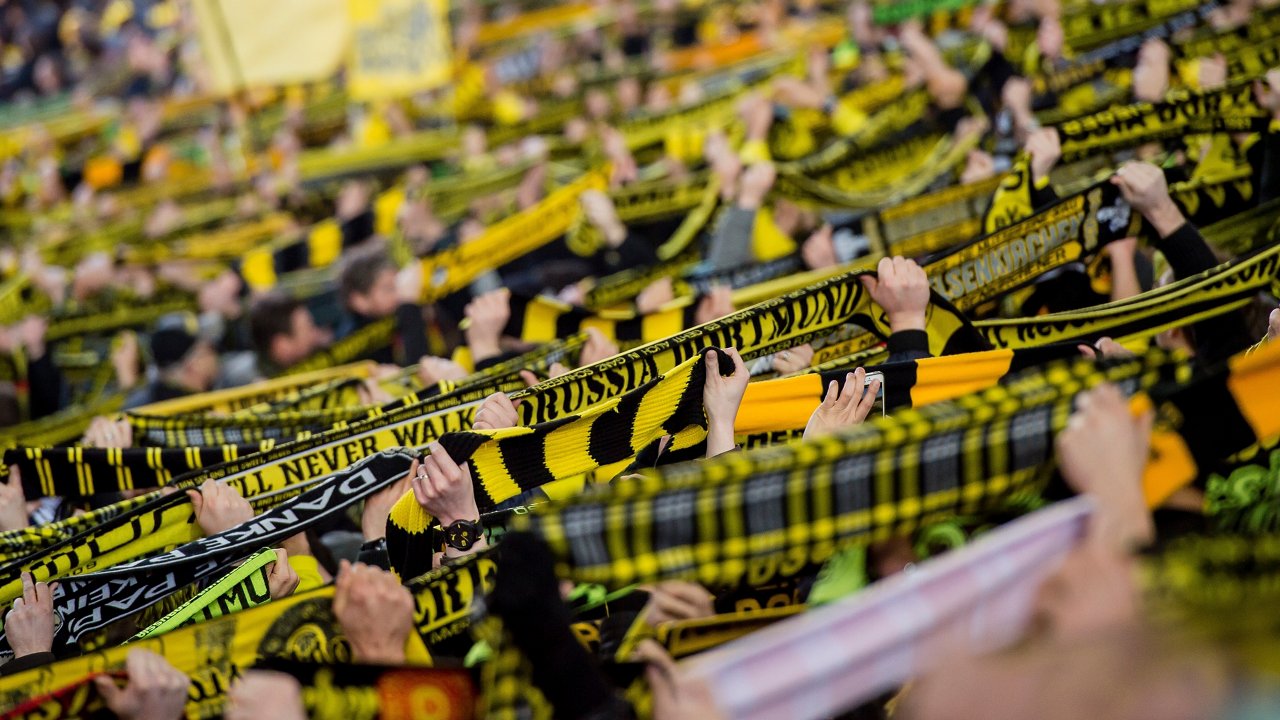
Karim chose a very special place for the interview with BORUSSIA: SIGNAL IDUNA PARK. Here, where the heart of football beats every fortnight. The biggest and, in our opinion, the most beautiful stadium in Germany.
What does SIGNAL IDUNA PARK mean to you? What makes you so happy here?
"I had my first contact with BVB in this stadium.I love being here.What the fans give us is impressive anyway. But even looking at the structure from the outside, to feel this power, it's special. I always get goosebumps when I come here. And when the fans welcome us with their songs as we warm up, it's incredible. There is no louder stadium than ours. I'm very happy to have a stand full of fans like this behind me. The stadium is special. It's really, really fun to play here."
Karim grew up in Munich. He was born on 18 January 2002. His father is Nigerian, his mother Romanian. As a child, he played basketball and volleyball as well as football. As an eight-year-old, he joined Bayern Munich's U9 team, but returned to his first club, TSV Forstenried, less than two years later. From 2012 to 2018, he played for youth set-up of SpVgg Unterhaching. Perennial Austrian champions FC Salzburg then secured the services of the highly talented attacking player when he was 16 years old, for an impressive transfer fee.
You played in Munich as a BVB supporter? How was that received?
"To be honest, that was after my time at FC Bayern. In his old job, my father drove a few people to a match in Dortmund and watched the game with them. When he got back, he told me that he had experienced an unbelievable atmosphere in the stadium. After that, we watched a lot of Dortmund on TV and we were always in favour of Dortmund. From then on, I had the desire: I absolutely want to play for Dortmund. I know what this club is, what the fans can give me. And the style of play suits me particularly well too. That's why I've felt very comfortable here since day one."
At what point in your youth did you realise that you were not only better than others, but possibly good enough for the top level?
"I can't answer that specifically. When I first touched a ball, I knew I wanted to become a professional footballer. I realised early on that I had more talent than others. I perhaps also believed more than others that I could make it. For me, there was nothing else beyond wanting to become a professional footballer."

On 20 February 2020, Karim Adeyemi made his debut for FC Salzburg's first team as a substitute in a Europa League away game to Eintracht Frankfurt (a 4-1 loss). He made his breakthrough in 2021/22: with 19 goals in 29 games, he finished the season as the top scorer in the Austrian Bundesliga. During his time in the Alps he won both the league and the cup three times. He has come close to winning trophies in Dortmund too. However, the medals have only been silver ones: in the Bundesliga in 2023 and in the UEFA Champions League in 2024.
How long did you dwell on that moment from the 21st minute of the match, when you were played in one-on-one with Real Madrid goalkeeper Courtois by Mats Hummels' pass?
"For a very, very long time. But I didn't let myself get dragged down about it. On the contrary. I don't want to experience moments like that again, so I'm working hard to be more determined in front of goal and to capitalise on my chances."
... which you were doing very well up until the beginning of October, with five goals and four assists for BVB and five goals for the U21 national team.
"Exactly. I'm no longer so worried about missing goalscoring opportunities. Of course, it would have been nice if I had found the back of the net in the final against Real Madrid. And of course I still have the images of Mainz in my head, and they will remain unforgettable. It still hurts very, very much that we couldn't capitalise on that moment. That's football. Hopefully we'll do better next time."
Will there ever come a time when you look back not only with disappointment at losing the final or the Bundesliga, but also with some pride at what you have achieved? 30 other top teams were knocked out before they made it to Wembley.
"Sure, there's always a loser. But we didn't win the final. It sounds strange, but it will probably never feel good, even though we achieved something incredible."
To create special moments on the pitch, you need to be slightly carefree. Franz Beckenbauer called these players who make the difference "magicians". But a magician can't be too mature either. How much lightness do you need to retain and how much seriousness is required to be successful?
"That's probably different for every player. For me personally, I've realised that I need more freedom than having to be serious on the pitch. When I played for the U21s in September, I was relaxed - even more relaxed than before in Dortmund. And that's when I realised that nothing can stop me when I'm relaxed. I played two good games for the U21s. I went into the next games at BVB with these thoughts: ‘If I play a bad game: it can happen, no problem! If I play a good game, I'll keep focusing on having fun'. And that worked. That's exactly how I'm going to approach the next few games. No matter what the people around me say. I'm going to do what's good for me."
So in hindsight, was it good for you that you weren't called up for the senior national team by Julian Nagelsmann in September, even though the personal disappointment was probably huge at the time?
“Absolutely! If I had got fit earlier, I would have been very happy to go to the November games for the U21s. Because that way helped me a lot.”

A project in Nigeria, his father's home country, shows what makes Karim Adeyemi tick. The young footballer is involved in social projects that focus on education and supporting disadvantaged children. Through his foundation, he wants to offer them access to educational opportunities to give them the chance of a better future. Poverty is deeply rooted in Nigeria, with over 40% of the population living below the poverty line.
What drives your projects?
"When I was ten years old, I went to Nigeria, the country of my ancestors, for the first time with my father and told him: ‘If I manage to realise my dream of becoming a footballer and earning enough money, then I want to come back and help the people here so that they can have a better future.' In the meantime, I have set up a foundation with my father that pays scholarships for school visits or provides people with food, drink and medicine. At the end of last year, we had a well built to provide fresh, clean water."
What was your childhood like?
"It wasn't easy for my parents to get by in Germany either. They had to work several jobs to just keep their heads above water. And I realised that people in Nigeria have even less. Now I want to give something back. If I ever have children, I will show them that not everyone has it as good and as easy as someone who was born and grew up in Germany."
What does your family mean to you?
"Family is special. I would love to have them here all the time. I have a very close bond with my mum and dad. But the people who are very close to me are also family to me, even if it's not the same blood. With my wife, a new family has come to me; it's very nice to have her."
Author: Boris Rupert
Photographer: Hendrik Deckers
The text comes from the members' magazine BORUSSIA. BVB members receive BORUSSIA every month free of charge. Click here to apply for membership.